Buying real estate leads shouldn’t feel like buying lottery tickets, yet sometimes it seems like throwing money at more names and hoping one eventually pays off. Whether you pay for leads or generate them yourself, tracking what happens after they enter your CRM can tell you which strategies are actually building your business. |
And leads aren’t the only place where it pays to look beyond the obvious options. Some investors are using a different kind of financing to take a second look at properties and neighborhoods traditional lenders might make harder to pursue. DSCR loans could open the door to more opportunities, but access to the money is only the first step in deciding whether the investment is worth it. |
|
|
|
Here's what you need to know today: |
|
|
|
With fewer transactions and more competition for clients, agents have less room to waste time or money on lead generation that doesn’t produce business. Agents can find clients in countless ways, from prospecting and farming to direct mail, working your sphere, hosting open houses, creating content, or paying for leads. But in today’s market, simply generating more names isn’t necessarily the answer. Agents should ask whether the leads they’re generating fit how they do business and, more importantly, whether they’re actually turning into clients.
|
That becomes especially important when you’re paying for leads. More than 3,500 users have turned to our guide on the best places to buy real estate leads, showing just how many agents are weighing their options. When comparing providers, look beyond price. Are the leads exclusive? Are they buyers or sellers? Is there a contract or additional ad spend? The cheapest lead isn’t necessarily the best value, especially if it never converts.
Agents also need to know whether their lead generation is actually paying off. Don’t just look at how many names enter your CRM. Track how many respond, start conversations, book appointments, sign agreements, and eventually close. Then compare that business with what you spend to generate it. A source delivering 100 cheap leads that go nowhere could be far less valuable than one producing 10 stronger prospects that actually become clients. If a strategy consistently takes your time and money without producing meaningful opportunities, it may be time to change the source, the follow-up, or both.
|
What this means for agents:
🎯 Find the lead type that fits you: If you love cold calling, prospecting leads may make sense. If you excel at immediate follow-up, high-intent online buyer leads could be a better fit. 💰 Track more than cost per lead: Conversations, appointments, signed clients, closings, and commission generated tell you much more about whether your money is working.
📲 Audit your follow-up: Sometimes the lead source isn’t the platform. Look at how quickly and consistently you respond and nurture prospects before writing a source off. |
|
|
|
What makes you most nervous when you arrive at a showing? |
|
|
|
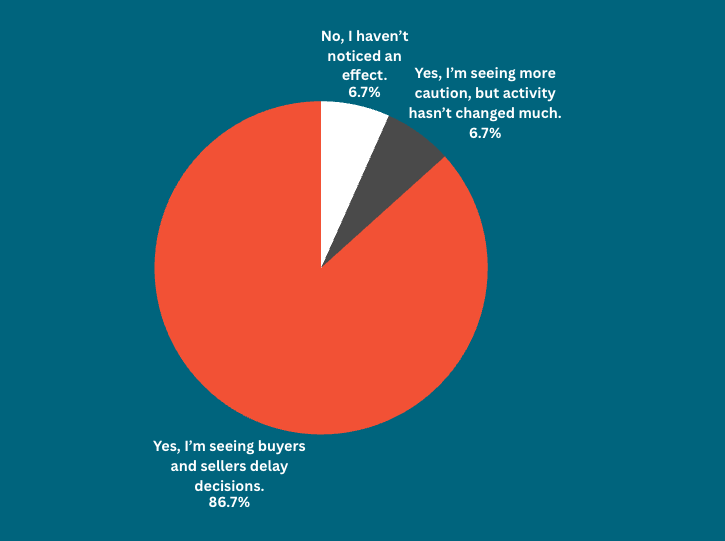
Are concerns about the economy affecting buyer or seller decisions in your local housing market? |
|
|
|
Some investors are finding opportunities in places traditional lenders once largely avoided. Debt service coverage ratio (DSCR) loans are helping investors buy, renovate, and rent vacant or dilapidated homes in markets including Indianapolis, Baltimore, Detroit, and Memphis. Instead of qualifying borrowers primarily on personal income, these private loans focus on the property’s value and its ability to generate enough rental income to cover the debt.
For investors, that can open a different pool of opportunities. Someone who finds a promising rental property but doesn’t fit traditional mortgage underwriting may have another financing option. It can also make lower-cost or distressed properties in overlooked neighborhoods easier to finance, potentially giving investors access to properties they can renovate and return to the rental market.
But easier access to financing doesn’t make the underlying investment safer. Investors still need to ensure realistic rents can cover the loan, renovation costs, taxes, insurance, vacancies, and maintenance. DSCR lending has also been susceptible to fraud, so due diligence matters even more. The opportunity isn’t simply that investors can borrow differently. It’s that different financing can make properties and neighborhoods worth evaluating that they may have previously overlooked. What investors should know about DSCR loans: |
- The property matters: Approval depends more on the property’s expected rental income than on the investor’s personal income.
- More markets become possible: Investors may find it easier to pursue lower-cost homes and distressed properties in overlooked neighborhoods.
-
Renovation can create opportunity: Vacant or neglected homes can potentially be improved and returned to the rental market.
|
Your Move This Week: 🧠 Learn how DSCR financing works. 👀 Revisit overlooked rental markets.
🔨 Run the numbers on distressed properties. |
|
|
|
Most people scrolling Instagram aren’t looking for a real estate agent. Coffee & Contracts Head of Member Education & Strategy Alyssa Jones recently made that point in an interview with The Close, and I think it gets to the heart of what agents should actually be trying to accomplish on social media. Instead of waiting until someone needs an agent to get their attention, give them a reason to follow you long before real estate is even on the radar.
For Alyssa, that started with local content. She shared what was happening around town, places she loved, and information her community actually cared about. The content wasn’t always about buying or selling a home, but that was precisely the point. It allowed her to build relationships with people before they needed her services. When real estate eventually became relevant, they already knew her. As she puts it, “People don’t need another real estate agent in their feed. They need a reason to care about following you in the first place.”
|
Getting the follow, however, is only the first step. Alyssa believes agents also need to share enough of their personality and perspective for people to remember them. That matters even more as AI makes polished content increasingly easy to create. A beautiful graphic isn’t much of a differentiator when anyone can make one in seconds. Your opinions, experiences, local knowledge, personality, and communication style are much harder to replicate. The goal is to reach the point where someone recognizes your content before they even see your username.
Then comes the part agents can easily overlook: whether that attention is creating real relationships. Alyssa cautions against focusing too much on followers, likes, and views. Instead, pay attention to DMs, replies, shares, saves, and people who mention your content or reach out already feeling like they know you. A million views might look impressive, but recognition and relationships are what create opportunities. Give people a reason to follow you, enough personality to remember you, and content that brings you closer to the people you want to work with.
|
|
|
|
Independent brokerages may look smaller on paper, but that doesn’t mean they have to compete like they’re at a disadvantage. A recent NAR article argues that local ownership can give independent brokerages something larger companies struggle to replicate: the ability to move quickly, know their agents personally, and build the brokerage around what’s happening in their specific market.
|
I think that’s worth looking at through a recruiting and retention lens. If you’re independent, ask yourself what agents get from your brokerage specifically because you’re local. Can you change a training based on what agents are seeing this week? Can an agent sit down with leadership when their business stalls? Are you involved enough in the community to understand what clients are experiencing? NAR also points out that technology is no longer necessarily a big-company advantage. Independent brokerages can access CRMs, AI tools, marketing platforms, and transaction technology, too. The differentiator is how well you help agents actually use them.
Most importantly, make sure agents know what makes your independence valuable. Local ownership alone isn’t a recruiting pitch. Highlight accessible leadership, personalized coaching, faster decision-making, community relationships, and a culture agents can actually feel. Audit what your brokerage offers that would be harder to recreate at a much larger company, then make sure you’re delivering on it and communicating it to current agents and potential recruits.
What’s working right now: |
- Define your independent advantage: Ask your leadership team to name three things agents get specifically because your brokerage is locally owned. If that’s difficult to answer, that’s a good place to start.
- Audit leadership access: How easy is it for an agent who is struggling to actually sit down with the broker or another decision-maker?
- Put your culture to the test: Ask whether agents experience your culture every week or whether it mostly exists in recruiting materials.
|
|
|
|
🏘️ Small investors are taking a bigger share of the market: Real Estate News says investors buying 10 or fewer homes accounted for a record 66.2% of investor purchases in the first half of 2026, as larger investors pulled back.
🎓 Some college towns may have built too much student housing: Realtor.com reports more than 31,000 off-campus bedrooms were delivered in 2026, but new properties averaged just 84.1% occupancy as falling rents and empty beds emerge in some once-undersupplied markets.
📉 High mortgage rates are pushing more buyers to pause: NAR highlights that pending home sales fell 7.3% in September and 11.3% from a year ago as rising borrowing costs outweighed growing inventory and increased seller flexibility. |
|
|
|
|
Sophia Doyle is a staff writer at The Close and a licensed New Jersey real estate agent with hands-on experience in residential real estate. Sophia brings real-world insight into today’s housing market, combining on-the-ground agent experience with a strong background in communications. She understands the full transaction lifecycle, from lead generation and client relationships to marketing strategy and deal execution. Through her writing, Sophia delivers clear, practical guidance to help agents navigate an evolving industry with confidence and creativity.
|
|
|
|
Advertise in The Close The Close is a TechnologyAdvice business © 2026 TechnologyAdvice, LLC. All rights reserved. TechnologyAdvice, 3343 Perimeter Hill Dr, Suite 215 Nashville, TN 37211, USA |
|
|
|
|