There’s a new voice in your client’s real estate group chat, and its name is AI. Buyers and sellers increasingly use it to research, strategize, and even decide what to offer. But that doesn’t mean they have stopped using agents. New Zillow data reveals what consumers still want from a real estate professional, and where their expectations are getting higher. |
And if your clients are getting comfortable with AI, you should be too. The Neuron Academy is a great place to sharpen those skills with practical courses you can apply to your everyday work. One course worth checking out is Use AI to Decode Email Threads and Stress-Test Your Reply, which teaches you how to use AI to make sense of complicated email conversations and pressure-test your response to determine what gets your clients to reply.
|
|
|
|
Here's what you need to know today: |
|
|
|
Buyers' and sellers' habits are changing, and agents need to evolve with them. Zillow’s 2026 Consumer Housing Report shows that clients are doing more research, using AI, thinking differently about affordability, and expecting more from their agents. Sellers are also becoming more realistic about what they want from a transaction. Maximizing profit remains the top priority for 52% of sellers, down from 58% last year, while 36% now prioritize selling within their desired timeline. In this market, getting the deal done is becoming a bigger part of the conversation.
|
Expectations around real estate marketing are also high. Nearly three-quarters of sellers say reaching the largest possible audience is very or extremely important, and sellers are more likely to hire agents who offer professional photography, virtual tours, and interactive floor plans. Yet there’s still a gap between what sellers value and what actually appears in listings. For agents, that means your marketing package isn’t just a tool to attract buyers. It’s increasingly part of the value proposition you use to win the listing.
Perhaps the biggest shift, though, is how much information clients already have before they talk to you. More than 80% of buyers and sellers use AI, and many use it during the transaction. Buyers are even asking AI tools what to offer and how to negotiate. At the same time, agents remain deeply involved early in the process: 95% of buyers contact an agent within their first three homebuying activities. Despite ongoing industry conversations about compensation, 76% of sellers and 78% of buyers said their agent’s commission was fair. Clients may have more tools and information than ever, but the data suggests they still see value in agents. However, the standard for earning that value is getting higher.
What this means for agents: 🤖 Expect more informed clients: Buyers and sellers may arrive with AI-generated pricing, market, offer, or negotiation advice. Be prepared to explain where that information is right, wrong, or missing important local context.
📸 Your marketing package matters: Professional photography, floor plans, virtual tours, and broad listing exposure can help you win the listing before they even start selling the home.
⭐ Make your value obvious: Most buyers and sellers still believe agent compensation is fair. Don’t assume they’ll automatically understand why. Your expertise, marketing, negotiation, communication, and ability to interpret information are what justify that value |
|
|
|
Are concerns about the economy affecting buyer or seller decisions in your local housing market? |
|
|
|
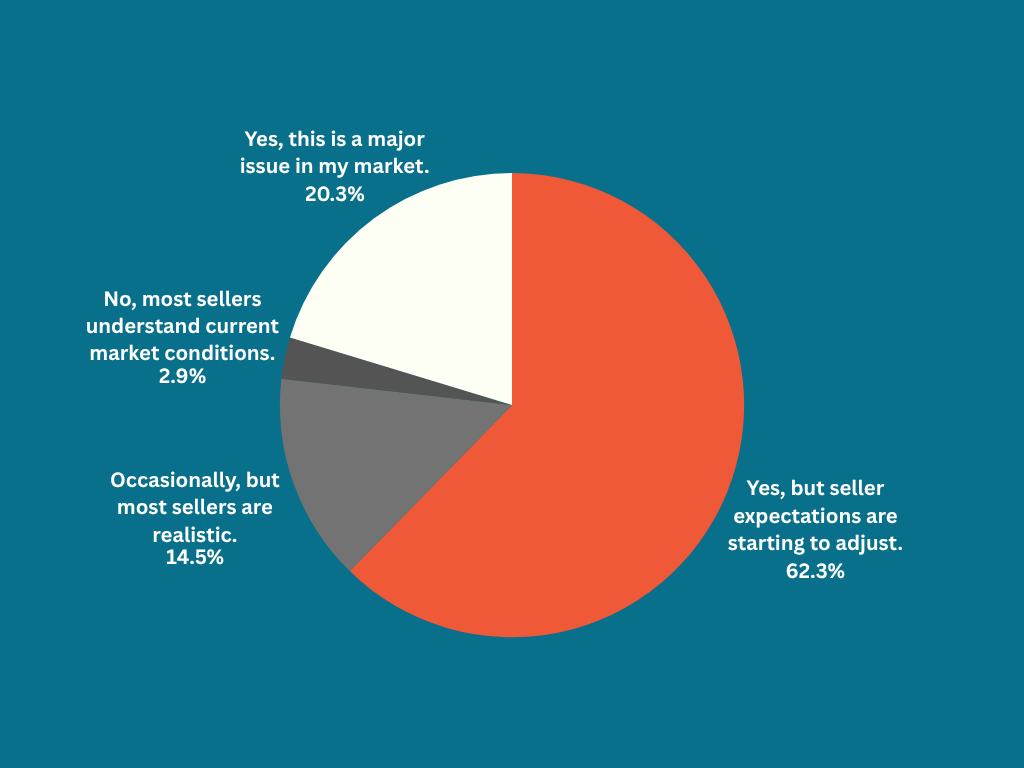
Are sellers in your market still expecting their homes to sell for more than they’re realistically worth? |
|
|
|
Financing is becoming a bigger part of the investment strategy. Mortgage rates are hovering around 7.4%, and higher borrowing costs are putting more pressure on investors to find deals where the purchase price, renovation costs, and eventual return still make sense. At the same time, investors who find a distressed property or time-sensitive opportunity may not have weeks to wait for traditional financing.
That’s where hard money can come into play. These short-term, property-backed loans are typically faster and more flexible than conventional financing, making them useful for fix-and-flips, distressed properties, major renovations, and other deals where speed matters. Finding the best hard money lenders can give investors another financing option when moving quickly matters. The goal isn’t necessarily to find the cheapest financing. It’s about deciding whether paying more for faster access to capital unlocks an opportunity that otherwise wouldn’t work.
But that flexibility comes at a cost. Hard money loans generally carry higher rates, fees, and shorter repayment timelines, so investors need to know exactly how they’ll exit the loan. A renovation delay, unexpected repair, or slower sale can quickly change the math. Before borrowing, run the deal using realistic holding costs and have a clear plan to sell, refinance, or otherwise repay the debt.
What investors should consider right now: |
- Speed vs. cost: Paying more for financing can make sense when moving quickly creates enough value to justify it.
- The opportunity: Distressed homes, flips, and properties requiring substantial work may be difficult to finance conventionally.
-
The full numbers: Calculate interest, points, fees, renovation expenses, and holding costs before deciding what you can afford to pay for the property.
|
Your Move This Week: 🧠 Learn how hard money financing works. 👀 Identify deals where speed could create an advantage. ⚖️ Compare the full cost of different financing options. |
|
|
|
The Agent Takeaway:
With Redfin finding that sellers outnumber buyers by a record margin, getting a listing is only half the battle. Agents need to prepare sellers for more competition, longer timelines, and buyers who have more options. That means pricing correctly from the start, closely monitoring competing listings, and ensuring the home stands out in condition, presentation, and value. For buyer’s agents, it’s also a reminder that there may be more room to negotiate on price, concessions, and other terms.
|
|
|
|
Open houses can be a great source of business, but only if agents know how to turn visitors into real opportunities. That’s where brokers can step in. Instead of simply encouraging agents to host more open houses, make open house training part of your brokerage playbook. Teach agents how to promote the event, capture useful contact information, start conversations with visitors, identify serious prospects, and follow up afterward. |
Then, start measuring what happens. A busy open house can feel successful, but attendance alone doesn’t tell you much. Have agents track verified contacts, booked appointments, acquired clients, and, eventually, any transactions that came from the event. If an agent consistently hosts open houses but gets very little business from them, look at where the process is breaking down. Are people signing in? Are agents qualifying visitors? Are they following up quickly? Are appointments being set?
Most importantly, don’t assume open houses either “work” or “don’t work” for your brokerage. Track the results and adjust. Compare performance by agent, neighborhood, price point, property type, and follow-up strategy. If open houses are producing clients, figure out what your strongest agents are doing and train the rest of the office on it. If they aren’t, identify what needs to change, or whether your agents’ time would be better spent on another lead generation strategy.
What’s working right now: |
- Roleplay open houses: Practice greeting visitors, asking questions, handling sign-ins, identifying potential clients, and setting a next step before they leave.
-
Create a brokerage scorecard: Have agents track attendance, valid contacts, appointments, clients, and closings from each event so you can see what’s actually producing results.
- Audit the last five: Review an agent’s last three to five open houses before deciding the strategy isn’t working. The article recommends looking across several events rather than judging based on one.
|
|
|
|
👷 Homeowners are remodeling instead of moving: Homes.com reports that nearly 6 in 10 homeowners completed an improvement project between 2021 and 2023, with 75.7% paying cash as high mortgage rates keep many owners in place.
⚡ 67 million Americans are under a power grid emergency: Realtor.com says an unusual October heat spell, aging infrastructure, and growing electricity demand from data centers are putting new pressure on the nation’s largest power grid.
💸 Buyers face a $23,000 affordability hurdle: Zillow states that the typical home would need to cost about $23,000 less to keep monthly payments at last year’s level, but sellers are largely holding firm despite buyers gaining negotiating power. |
|
|
|
|
Sophia Doyle is a staff writer at The Close and a licensed New Jersey real estate agent with hands-on experience in residential real estate. Sophia brings real-world insight into today’s housing market, combining on-the-ground agent experience with a strong background in communications. She understands the full transaction lifecycle, from lead generation and client relationships to marketing strategy and deal execution. Through her writing, Sophia delivers clear, practical guidance to help agents navigate an evolving industry with confidence and creativity.
|
|
|
|
Advertise in The Close The Close is a TechnologyAdvice business © 2026 TechnologyAdvice, LLC. All rights reserved. TechnologyAdvice, 3343 Perimeter Hill Dr, Suite 215 Nashville, TN 37211, USA |
|
|
|
|