Imagine opening your property tax bill and seeing a big fat $0. Sounds pretty nice, right? Florida voters could soon vote on a proposal that would dramatically reduce what homeowners owe. But before we celebrate lower housing costs, there’s a catch: cutting one expense could make another go up. |
Apparently, this week's theme is real estate plot twists. Lower property taxes could raise home prices, while a New Jersey strip mall that couldn’t get its redevelopment plans off the ground has found an entirely different way to make itself useful. This one is especially fun for me because I know the property firsthand. |
|
|
|
Here's what you need to know today: |
|
|
|
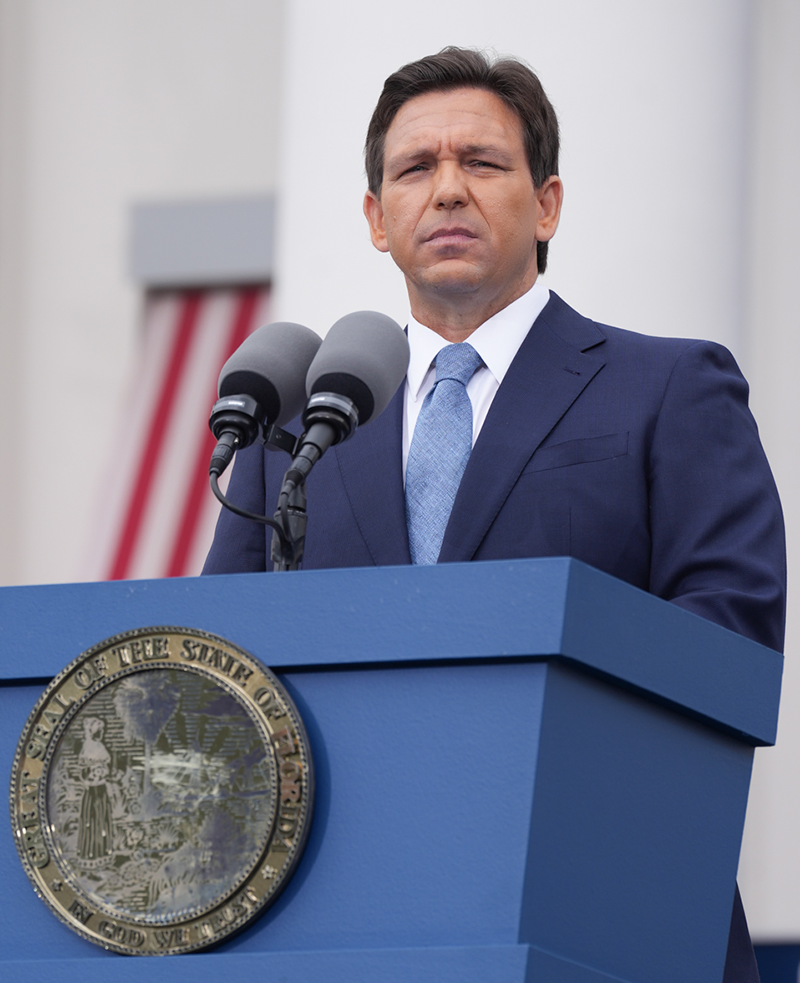
What if you could own a home without paying property taxes? Florida voters could soon decide whether to move toward that reality. A proposed constitutional amendment, Amendment 3, would increase the state’s homestead exemption from roughly $50,000 to $150,000 in 2027 and $250,000 in 2028. That means eligible homeowners would pay property taxes on a smaller portion of their home’s assessed value, potentially eliminating certain property taxes for many primary residences. Governor Ron DeSantis estimates the change could eliminate property taxes for 60% of Florida homeowners. The proposal needs 60% voter approval to pass.
|
Photo via Florida Governor’s Office |
For Florida homeowners, the immediate appeal is obvious: lower annual housing costs, particularly in a state already dealing with expensive insurance and HOA fees. But there’s a catch. Realtor.com estimates that eliminating property taxes could push Florida home values up 7% to 9% as buyers become willing to pay more for homes with lower ongoing costs. That could benefit existing homeowners while making it harder for first-time buyers to enter the market. There’s also the question of how local governments would replace the lost revenue used to fund services such as police, fire departments, and infrastructure.
And Florida could become an important example for the rest of the country. If other states pursued similar exemptions, the housing market could see a shift in how buyers evaluate affordability. Lower property taxes might attract more buyers, increase competition, and support higher home prices, potentially offsetting some of the savings. Meanwhile, states and municipalities would have to decide whether to reduce services or shift more of the tax burden elsewhere. Eliminating a major homeownership expense doesn’t necessarily make housing more affordable if buyers end up paying more for the home itself.
What this could mean for the market: 🏠 Home prices could rise: Lower ownership costs may increase what buyers are willing to pay, particularly in desirable markets.
💰 Existing homeowners could benefit more than new buyers: Current owners could see lower tax bills and higher property values, while first-time buyers may face higher purchase prices. 📈 Buyer demand could increase: States offering substantial property tax relief might become more attractive to buyers comparing long-term housing costs. |
|
|
|
Are sellers in your market still expecting their homes to sell for more than they’re realistically worth? |
|
|
|
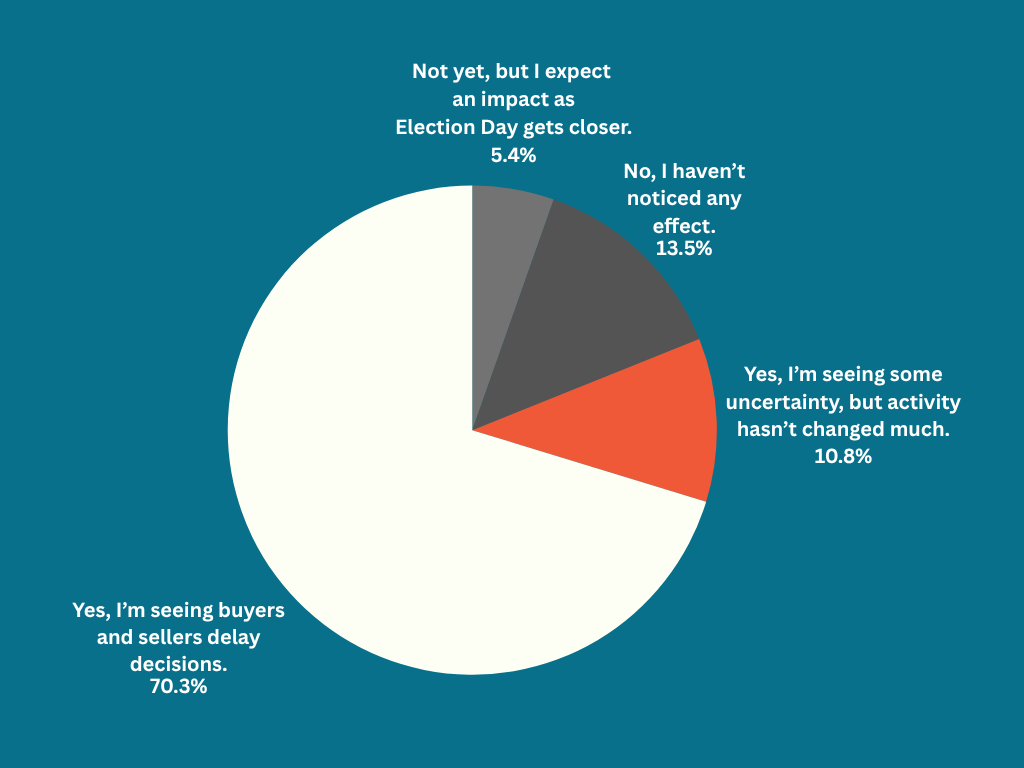
Are the upcoming midterm elections affecting your local housing market? |
|
|
|
This one hits close to home for me. My brokerage was based in Wayne, New Jersey, and I know the Preakness Shopping Center well. For years, parts of the once-busy strip mall have sat empty while plans to replace the space with 244 apartments stalled as interest rates and construction costs climbed. Now, those abandoned storefronts have found an unexpected second life: they’ve been transformed into an elaborate 1980s Miami set for the upcoming Miami Vice ‘85 movie.
|
Photo via NJdotcom Instagram |
This offers an interesting lesson for investors with vacant or underused properties. Redevelopment isn’t the only way an empty building can make money. That may be particularly relevant in New Jersey, where Netflix is investing nearly $1 billion to transform the former Fort Monmouth Army base into a major East Coast production hub. As more productions film across the state, storefronts, warehouses, offices, homes, parking lots, and other unconventional properties could temporarily serve as sets or production space.
Film production is only one possibility. Pop-up retail, seasonal stores, events, storage, and short-term leases can also generate income while an owner waits for the long-term opportunity. When financing and construction costs make redevelopment difficult, investors can ask a different question: What can this property earn in the meantime? Not every abandoned strip mall will become a movie set, but a property that looks obsolete may have more than one path to generating revenue. What investors are looking for: |
- Production potential: Large, flexible spaces, parking, distinctive architecture, and proximity to production hubs can make properties useful for filming.
- Temporary tenants: Pop-ups, seasonal retailers, events, and short-term leases can put otherwise empty space to work.
-
Existing structures: An outdated building may have value precisely because it hasn’t been modernized.
|
Your Move This Week: 🎬 Research local filming demand. 🤔 Consider temporary uses.
💰 Calculate the cost of a property remaining vacant. |
|
|
|
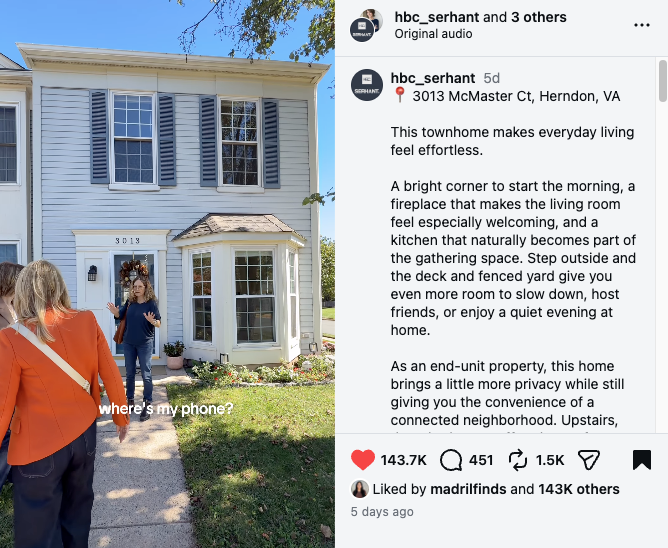
Some of the best listing videos don’t feel like they're selling anything at all. In the Reel I’m spotlighting, it starts with three real estate agents walking out of a home, casually talking about the price and features they saw. Then one of the agents realizes she may have left her phone inside. All three head back in to find it, giving them the perfect excuse to take viewers through the property.
Instead of walking from room to room and listing features, the agents keep commenting naturally as they search. The missing phone gives the video a simple storyline, while the property tour happens simultaneously. You want to see whether they find the phone, but along the way you also see the rooms and hear what stands out about the house. It makes the listing part of the entertainment, not the whole reason someone watches. |
Screenshot via hbc_serhant’s Instagram |
And people clearly watched. The video received more than 143,000 likes, 1,500 reposts, and 450 comments. What I particularly like about the concept is how achievable it feels. There’s no elaborate production or complicated premise. It requires a home, a phone, a few agents, and a simple storyline. The creativity comes from how the property is presented, not how much money or production went into it.
The broader lesson is that agents don’t have to reinvent the listing video. Sometimes they just need to give viewers another reason to watch one. A small storyline, running joke, challenge, or unexpected premise can turn a familiar home tour into content that feels native to social media. The house still gets plenty of screen time, but viewers don’t feel like they’re watching another advertisement. With more than 143,000 likes, that’s a pretty compelling argument for making the marketing feel a little less like marketing.
|
|
|
|
When was the last time you searched for your brokerage in ChatGPT, Gemini, or Google AI Mode? Google recently expanded its AI-search reporting to give businesses more information about how their websites appear across AI-powered and visual searches. And it’s not just potential buyers and sellers who may be searching this way. Agents considering a brokerage could also use AI to research companies, compare options, and decide where they want to work.
|
Think about the questions both groups might ask. A consumer might search, “What are some real estate brokers in [city]?” while an agent might ask, “What are the best brokerages to work for in [market]?” or “Tell me about [brokerage name].” Check whether your brokerage appears, what AI says about it, which competitors are mentioned, and whether information about your locations, specialties, culture, training, leadership, and contact details is accurate.
I’d make this a regular brokerage audit rather than a one-time experiment. Google’s new reporting can also help you see which pages on your website are getting exposure. You can’t guarantee an AI tool will recommend your brokerage, but you can ensure the information it finds about your company is accurate, consistent, and reflects the brokerage you want prospective clients and agents to discover.
What’s working right now: |
- Audit your brokerage website: Make sure key pages about your brokerage, agents, markets, services, training, and culture are up to date and accessible to search engines.
-
Check what AI gets wrong: Look for outdated office locations, leadership, specialties, contact information, or other inaccuracies, then trace those details back to the sources AI is using and correct them where possible.
- Put it on the calendar: Repeat the audit periodically and after major changes to your brokerage. AI answers can change, so don’t stop checking just because it looks accurate today.
|
|
|
|
🏨 Hotels may look like real estate, but the real risk is in the operation: Family Wealth Report explains why hotel investors need to scrutinize management, labor, revenue strategy, and capital needs just as closely as the property itself.
🏢 Office real estate is facing a surprising scarcity problem: CNBC says demand is recovering faster than supply, with premium office space increasingly scarce, and trophy-space rents up more than 20% from a year ago.
🎓 Luxury buyers are paying attention to public schools: Realtor.com finds top-rated elementary schools are helping attract high-end buyers, with Naples-Marco Island warning the highest average school rating among the luxury markets analyzed. |
|
|
|
|
Sophia Doyle is a staff writer at The Close and a licensed New Jersey real estate agent with hands-on experience in residential real estate. Sophia brings real-world insight into today’s housing market, combining on-the-ground agent experience with a strong background in communications. She understands the full transaction lifecycle, from lead generation and client relationships to marketing strategy and deal execution. Through her writing, Sophia delivers clear, practical guidance to help agents navigate an evolving industry with confidence and creativity.
|
|
|
|
Advertise in The Close The Close is a TechnologyAdvice business © 2026 TechnologyAdvice, LLC. All rights reserved. TechnologyAdvice, 3343 Perimeter Hill Dr, Suite 215 Nashville, TN 37211, USA |
|
|
|
|